
THIS ARTICLE WILL HELP YOU:
Manage Variations During Testing
You can stop variations during the experiment at any time.
To do this, you go to the Report and you stop a variation by clicking its status. This will pause the variation and will take this change into consideration on experiment results.
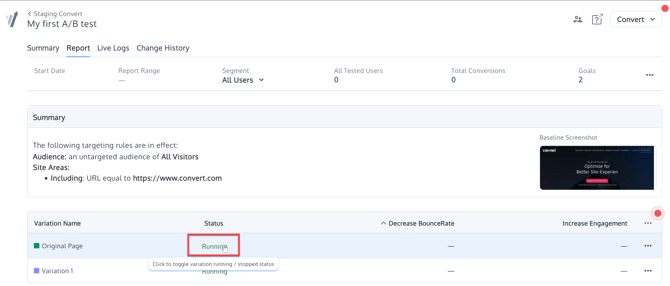
Stopping a variation prevents new visitors from being assigned to that variation.
Keep in mind that pausing a variation changes the conditions of the experiment. From that point onward, the original traffic allocation and randomization are no longer maintained, so the statistical validity of the test should not be considered continuous across the period before and after the variation was stopped.
Restarting a stopped variation
You can also restart a variation that was previously stopped in an A/B, Split URL, or multipage experience.
When restarting the variation, Convert displays a “Traffic allocation at Restart” step where you can review how traffic will be allocated after the variation resumes.
The traffic split can only be edited while the experience is still within its first 1,000 visitors. After that threshold has been reached, the traffic allocation cannot be changed during the restart process.
Restarting a variation resets its historical data
When you restart a stopped variation, Convert warns you that the variation’s historical data will be reset.
The confirmation shown in the app is “Start Variation And Lose Data.”
This means you should review and export any historical results you need before restarting the variation. Once restarted, do not treat the new results as a continuation of the previous variation data.
Best practice
If maintaining statistical validity and a clean comparison is important, consider cloning the experience and starting a new test instead of stopping and later restarting a variation. This preserves the original experiment’s historical results and gives the new test a fresh allocation and reporting period.