
THIS ARTICLE WILL HELP YOU:
Introduction
Is A/B Testing allowed by Google?
Am I going to get penalized in Google Search results because of cloaking?
This article guides you through the definition of cloaking, provides some cloaking examples and then instructs you on how to avoid Google's cloaking penalties by creating your experiments in Convert Experiments.
What is Cloaking
Google suggests that if they detect cloaking on your site you may be removed entirely from the Google index.
So what does cloaking mean? Simply put, you display different content to search engine bots and to humans to manipulate your search engine rankings. Most of the cloaking scripts identify the IP of the user agent (humans or search engine bots) and, based on a predefined list of IPs of search engine bots, will guess if the visitor is a search engine or a human. Other scripts use "traps" to identify robots. Based on who’s visiting your site, you can set up your web server to serve the tricky content to the search engine and nice-looking content to the human.
Some historical information on cloaking if you are interested:
Cloaking content was mentioned in the early days of search engines (around the 1990s). In those days, SEO was all about keyword stuffing. So, smart SEO geeks used to display a page full of keywords when a search engine bot visited to crawl/index the page. While if a user visited the same page, they displayed the default (normal) version. This strategy of keyword stuffing used to work like wonders so naturally, search engines started devising clever ways to detect and penalize such cloaking. But thanks to Google’s PageRank algorithm, keyword stuffing no longer works.
Examples of Cloaking
Some examples of cloaking include:
- Serving a page of HTML text to search engines while showing a page of images or Flash to users
- Inserting text or keywords into a page only when the User-agent requesting the page is a search engine, not a human visitor
Use Convert Experiments to avoid Cloaking
The Convert experimental setup is designed specifically to avoid any issues with cloaking, as long as you keep a few things in mind.
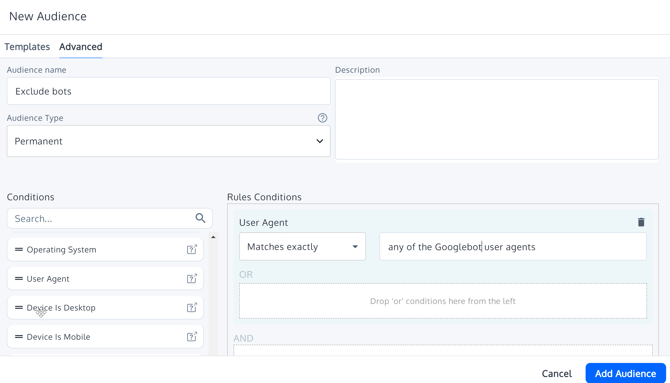
Do not distinct on Googlebot User-Agent
As long as you are not basing your traffic allocation on a search engine vs. human distinction (using Googlebot user-agent in Audiences feature) you will not be punished for cloaking. Google doesn’t care if its bot sees one version or another; it just cares that its bot has the same user experience as that of a random visitor.
Use rel="canonical"
If an A/B test has multiple URLs, place the rel=canonical link attribute on all of your alternate links, pointing to your original page. This will help point bots index your website to your original page. Experiments involving redirects should be fine if they don't redirect to unexpected or unrelated content.
Convert Web Testing Split URL experiments redirect visitors in the browser using JavaScript. They do not send an HTTP 302 response from your web server. As a result, a request to the original URL can return 200 OK before Convert redirects the visitor to the variation URL.
For Split URL experiments, use rel="canonical" on the variation page and point it to the original URL, as described above.
If your implementation specifically requires a server-side HTTP 302 redirect, implement the traffic split server-side or at the edge rather than relying on a Web Testing Split URL experiment. Convert Full Stack can be used for server-side experimentation.
Only run the experiment "as long as necessary."
You can run an experiment if there is sufficient traffic to justify it in the first place and either shut it off if it fails to conclude within your estimated timeframe or immediately after it does.
Keywords: google indexing prevention